Bikaboo
A voice-first AI ordering kiosk built to make self-service ordering feel more natural — combining speech, language models and product logic inside a physical retail experience.
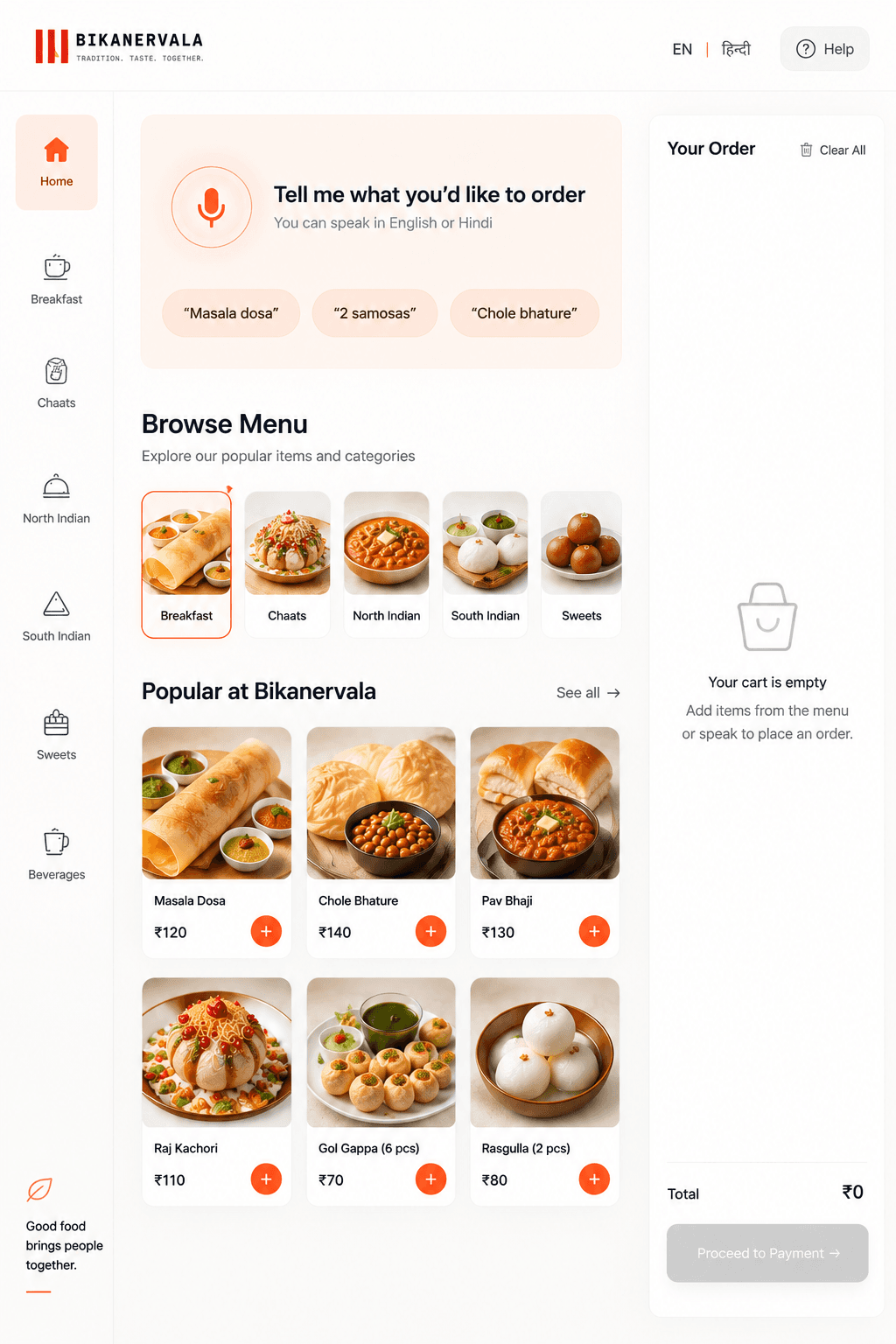
- Speech, not taps
- On-kiosk inference
- Deterministic, not model-driven
- Physical kiosk
Problem
Self-ordering kiosks are designed around screens, menus and taps. But ordering food is already something people know how to do naturally: they speak.
The challenge was to build an interface that could understand a customer’s request, translate that conversation into a structured order, and still keep the experience fast, predictable and easy to use.
Approach
Instead of treating AI as a feature layered onto a traditional kiosk, I designed the interaction around conversation from the beginning.
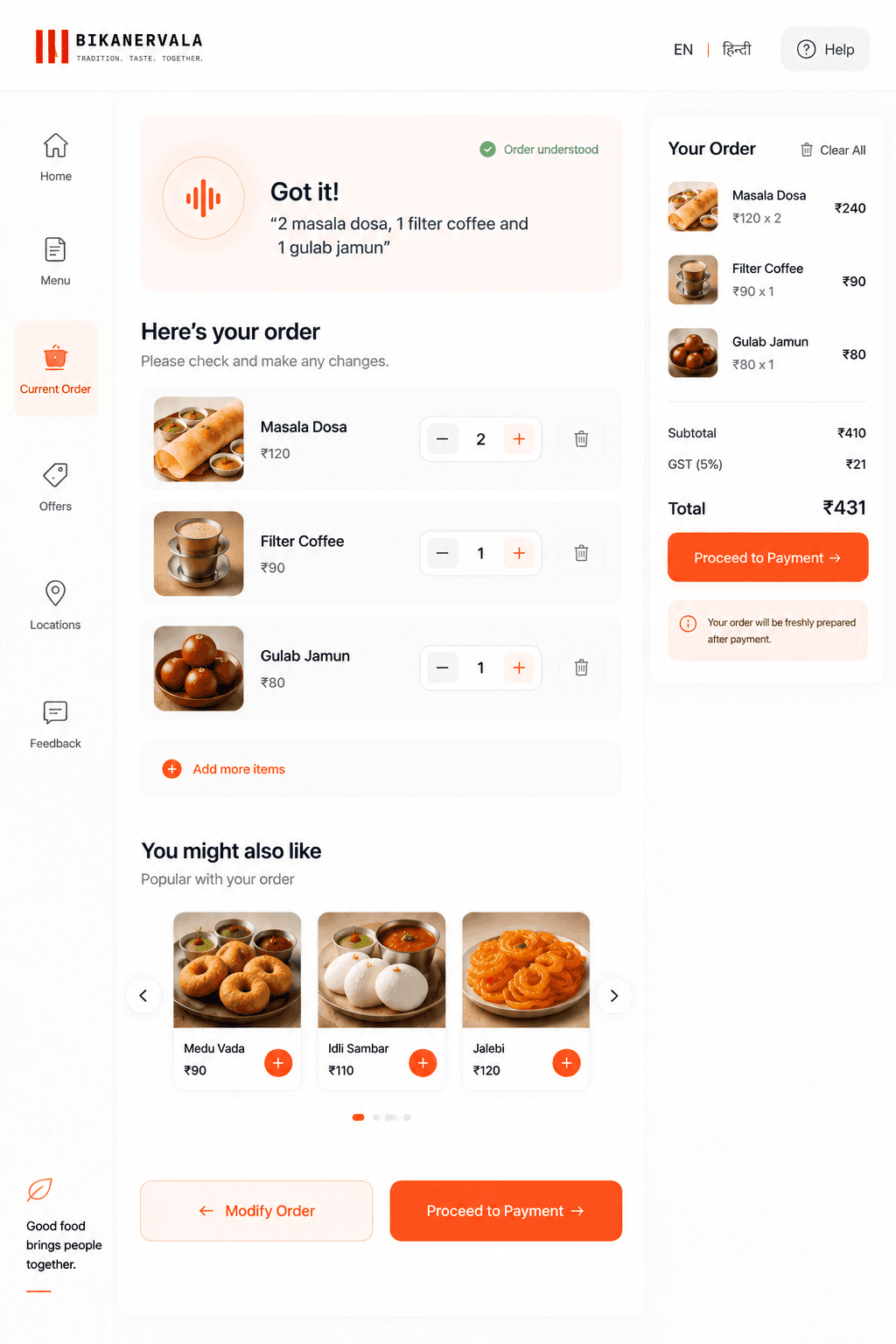
Speech becomes the input. Language models handle the ambiguity. Deterministic product logic handles the actual order. The interface keeps the customer informed throughout the process.
Architecture
Voice Input
Customer speaks naturally instead of navigating menus manually.
Speech Recognition
The spoken request is converted into text that the system can reason over.
Language Understanding
The system interprets intent, items, quantities and modifications from the request.
Product Logic
The interpreted request is converted into structured actions rather than allowing the model to directly control the application.
Kiosk Interface
The interface reflects what the system understood and gives the customer a clear path to confirm the order.
Hardware
The AI experience runs as part of a physical kiosk rather than existing only inside a browser.
The model never drives the application directly. It produces an interpretation; product logic decides what, if anything, happens to the order.
The interesting part
The difficult part wasn’t getting a model to understand a sentence. It was making that understanding reliable enough to become an actual transaction.
AI is probabilistic.
An ordering system can’t be.
So the architecture separates interpretation from execution — letting the model understand what the customer means while application logic remains responsible for what actually happens.
Hardware
The project extends beyond software. The system is designed around a physical kiosk, with AI inference and application logic running within a constrained hardware environment.
- NVIDIA Jetson
- Android
- Speech AI
- LLMs
Stack
Outcome
A working voice-first ordering experience that brings conversational AI into a physical retail environment — connecting speech, reasoning, product logic and interface into one system.