NexShape3D
A generative 3D platform that turns an idea into a printable model — combining image generation, iterative refinement and automated 3D model generation into one workflow.
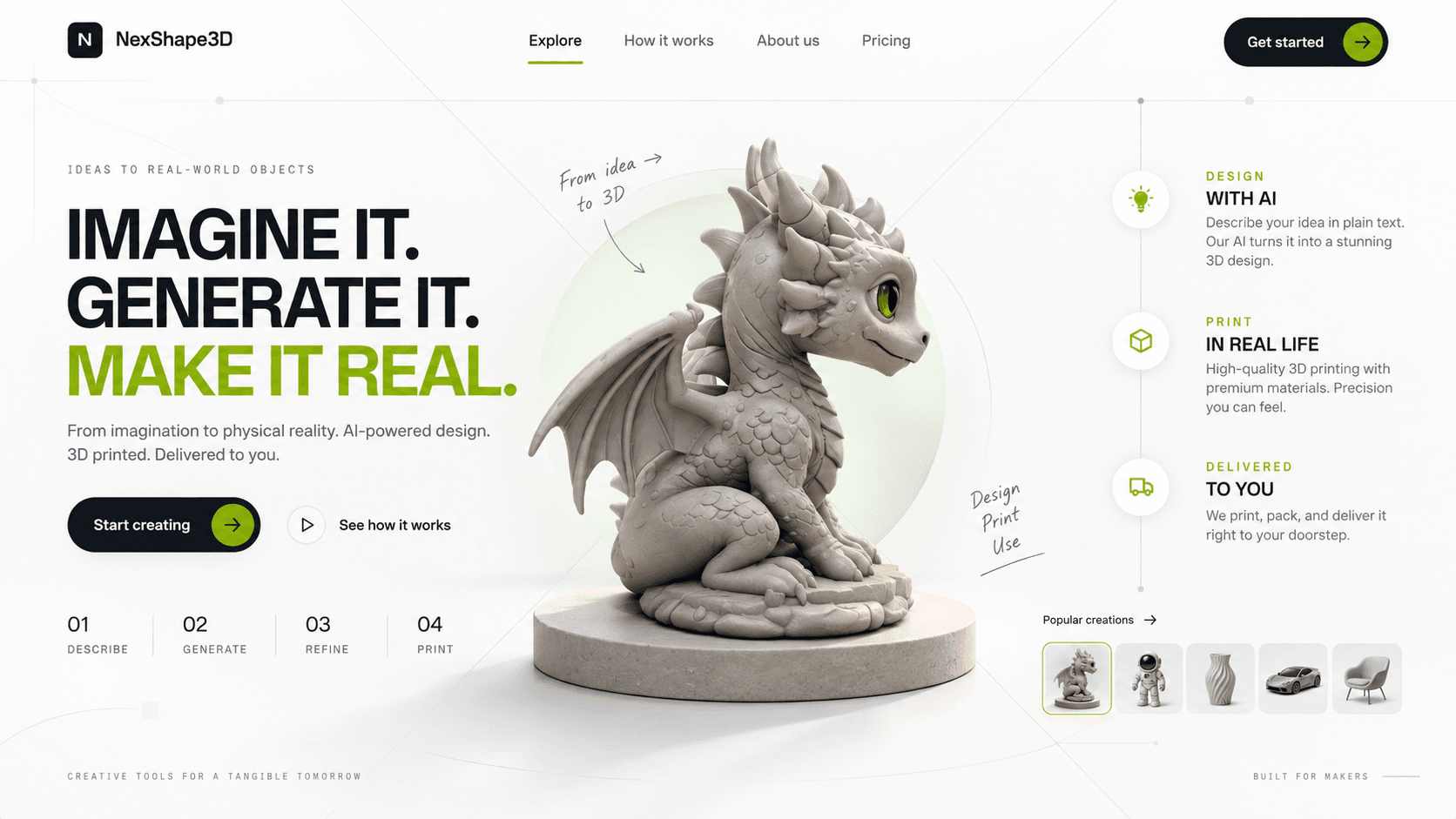
Problem
Creating a custom 3D model usually means knowing how to model, finding the right designer, or navigating several disconnected tools.
The idea behind NexShape3D was to collapse that process into a single flow: describe what you want, refine the concept, and turn it into a 3D model.
Approach
Instead of asking users to start with a complicated 3D editor, NexShape3D starts with something much simpler: an idea.
A user describes the object, generates a visual concept, iterates on it, and then sends the finalized design through a multi-image 3D generation pipeline.
Workflow
Describe
The user starts with a natural-language description of the object they want to create.
Generate
The prompt is turned into a visual concept, giving the user something tangible to evaluate before generating the 3D model.
Refine
The image can be iteratively edited until the concept is ready.
Prepare
Once the image is finalized, the system generates three fixed-angle views of the design.
Generate Model
Those views are automatically sent to the 3D generation pipeline, where they are used to create the corresponding 3D model.
Print
The resulting model becomes the starting point for the physical production workflow.
The interesting part
The 3D model isn’t generated directly from a sentence. NexShape3D uses an intermediate visual representation to give the user control over the design before committing to 3D generation.
See it first. Change it.
Then build it.
The visual step is what makes the interaction intuitive: the user evaluates something they can actually see, rather than guessing how a sentence will be interpreted in three dimensions.
Designing the loop
Generative interfaces can easily become one-shot experiences: enter a prompt, receive a result, start again.
NexShape3D treats generation as an iterative process instead.
The user can keep refining the visual output until it matches the idea they started with.
Architecture
Natural-language prompt
Generate the initial visual concept
Iteratively modify the generated image
Create three fixed-angle views
Send views to the Meshy API
Generated 3D asset
The finalized concept is not sent to 3D generation as a single picture. Three fixed-angle views are produced from it first, so the model is reconstructed from more than one direction.
Product logic
Credits
Generation isn't treated as an unlimited black box. Different actions have different costs, with image generation and subsequent editing handled through a credit-based system.
Two-stage generation
Separating visual generation from 3D generation gives users a chance to resolve the concept before spending the heavier computation required to create the model.
No unnecessary complexity
Rather than exposing a traditional 3D modelling interface, the product keeps the interaction focused on the thing the user actually cares about: what they want to make.
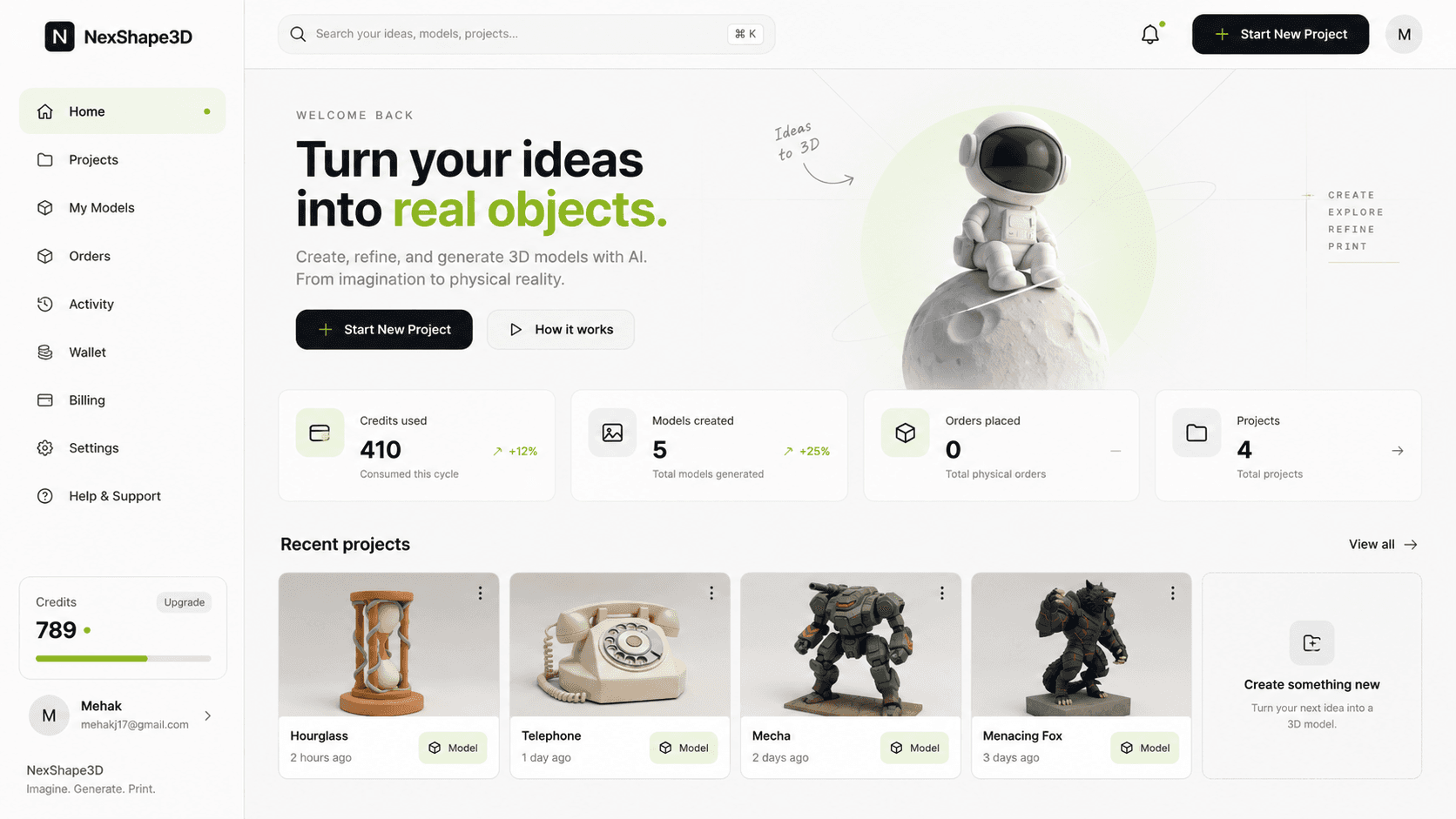
Outcome
NexShape3D turns a traditionally technical 3D creation workflow into a guided generative process — moving from language to image to multiple views to a 3D model.
The result is less about replacing 3D modelling and more about making the first step dramatically easier: having something worth modelling in the first place.